The Night Shift at the Morgue
· 13 min read
At two seventeen in the morning, Clara Montes received a body registered under the name of a man who was still alive. The night shift at the municipal morgue usually passed without surprises. A road…
Part 1 — Open case
At two seventeen in the morning, Clara Montes received a body registered under the name of a man who was still alive.
The night shift at the municipal morgue usually passed without surprises. A road accident, an unidentified person, a natural death waiting to be transferred. Clara had worked there for six years and had learned to recognise the building’s sounds: the motors of the refrigerated chambers, the wheels of the stretchers, the metallic slam of the doors and the constant hum of the lights.
That night, a white van stopped beside the service entrance.
The driver handed her a folder.
—Urgent transfer —he said.
Clara looked at the form.
Andrés Rivas. Sixty-seven years old. Male. Awaiting autopsy.
She knew the name.
Andrés Rivas had been an investigating judge for more than thirty years. He had retired recently, but he still appeared in the newspapers because he had reopened several old cases involving disappearances and police corruption.
—Where is he from? —Clara asked.
—A private residence.
—Who signed the certificate?
The driver pointed to the last page.
The signature belonged to Dr Lucía Barea, the director of the morgue.
Clara looked up.
—Dr Barea is inside.
—I was told to leave the body and go.
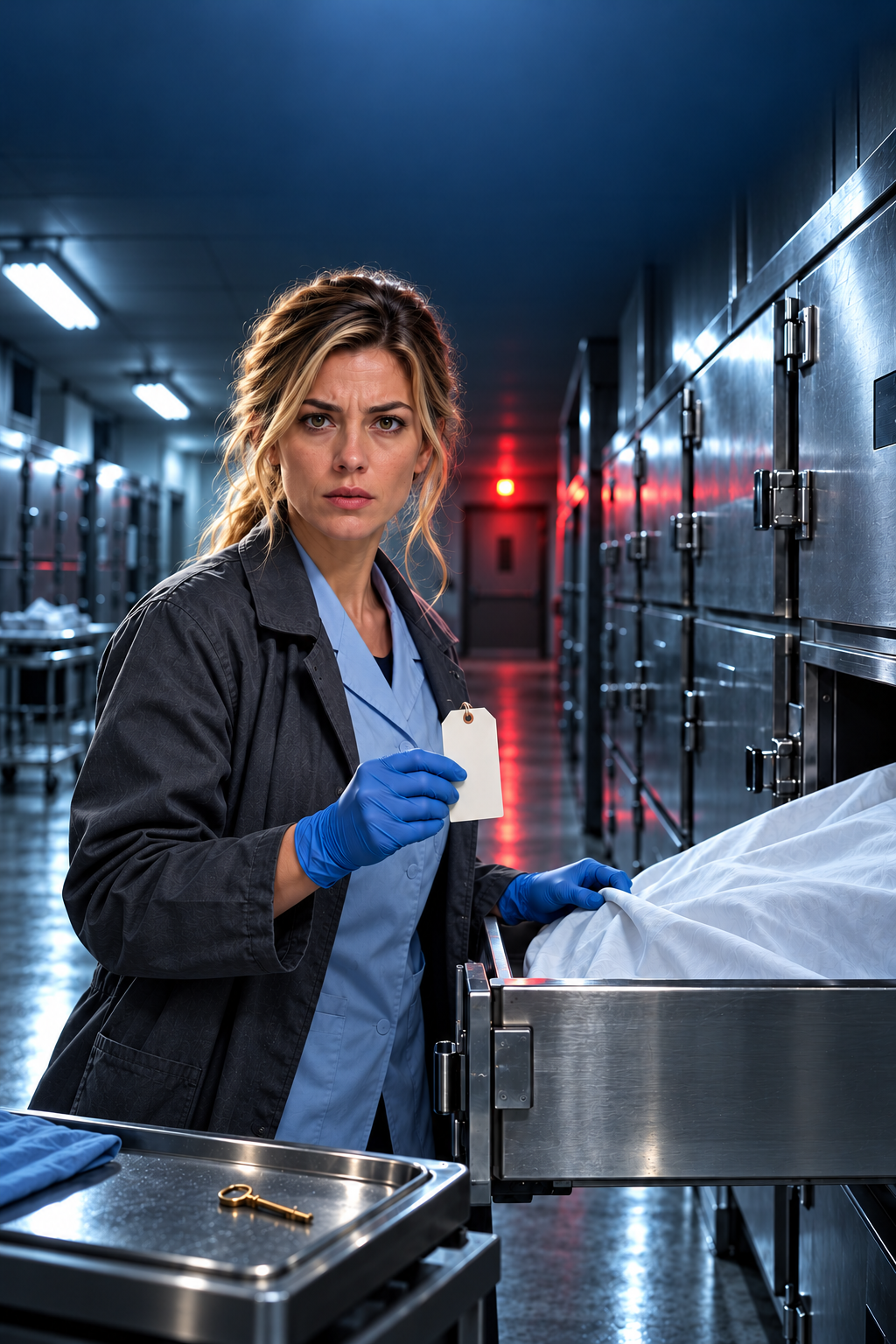
The man unloaded the stretcher. The body was covered up to the neck. It had no hospital bracelet, only a plastic tag tied around the ankle.
Clara took the stretcher to chamber four. Before placing the body inside, she checked the tag.
The face did not match any photograph of Andrés Rivas she had seen in the newspapers.
It was a man in his fifties, with grey hair and an old scar on his left wrist. A faded tattoo covered his forearm: a black triangle crossed by a line.
Clara looked at the tag again.
Andrés Rivas.
She opened the computer system. The record had already been created.
The arrival time was listed as 1:58 a.m., seventeen minutes before the van had arrived.
The document had been validated using Dr Barea’s account.
Clara picked up the telephone in the room and searched for Andrés Rivas’s number in a public database. She called.
Someone answered after four rings.
—Yes?
Clara recognised the voice from television interviews.
—Mr Rivas?
—Yes.
—I’m Clara Montes, from the municipal morgue.
There was a pause.
—Why is the morgue calling me?
Clara looked at the body beneath the sheet.
—I need to confirm some identification details.
—I’m at home.
—Are you alone?
—No. My daughter is with me.
—Are you feeling all right?
—What is happening?
Clara did not answer immediately.
—Do not leave the house —she said.
—What?
—Lock every door and call the police.
—Why?
Clara looked at the body again.
—Because there is a body here registered under your name.
Rivas said nothing.
Then he asked:
—Is Dr Barea on duty?
—Yes.
—Do not tell her anything.
The call ended.
Clara put the phone in her coat pocket.
The door opened.
Dr Barea entered wearing a dark coat over her uniform.
—What are you doing with that body outside the chamber? —she asked.
—The time on the record is wrong.
—I will correct it later.
—The name also appears to be wrong.
Barea looked at the tag.
For a moment, her expression changed.
—Did you call Rivas?
Clara did not answer.
—I asked you a question.
—His number was on the form.
—Do not make calls from this room again.
—The man is alive.
Barea moved closer to the stretcher.
—You do not know that.
—I have just spoken to him.
Dr Barea looked towards the refrigerated chamber.
—Put the body inside and close the door.
—I need official identification.
—You will have it in the morning.
—What if the name is false?
Barea removed her gloves.
—Then we will correct the name.
The doctor left the room.
Clara waited several seconds before placing the stretcher inside chamber four.
While moving the body, she felt something hard beneath its back. She lifted it slightly and found a small brass key sewn into the lining of the jacket.
The key had a metal plate attached to it.
M-17
Clara put it in her pocket.
At six fifty-three, her phone received a news alert.
Retired judge Andrés Rivas found dead at home.
Clara opened the link.
The article said that Rivas had been found in his study, sitting beside the window. The door had been locked from the inside. His daughter had called the emergency services at six twenty.
The estimated time of death was six forty.
Clara returned to chamber four.
The door was open.
The stretcher was still there.
The body was gone.
The tag remained on the floor.
Clara called Barea, but nobody answered.
Then she called the police.
Inspector Irene Lobo arrived twenty minutes later. She was a tall woman of about forty, with short hair and a black notebook in her hand.
—Tell me everything from the beginning —she said.
Clara told her everything.
Lobo listened without interrupting.
—Are you certain the body was here?
—I placed it inside myself.
—And now it is gone?
—Yes.
The inspector entered the chamber.
On the floor beside the door was a narrow, dark mark.
It was not blood.
It looked like funeral wax.
—Who has access to this area? —Lobo asked.
—Dr Barea, the transfer staff and me.
—Do the cameras work?
Clara pointed towards the monitor.
The recording from chamber four was damaged between two ten and two twenty-six.
Lobo looked at the screen.
—Exactly during the transfer.
—The system entry was created before the van arrived.
—Who signed the document?
Clara showed her the folder.
Lobo read Barea’s signature.
—And who is listed as responsible for the transfer?
Clara looked at the final line.
Clara Montes.
—I did not sign this.
Lobo raised her eyes.
—Your name is here.
—Someone forged it.
—Who knew your identification number?
Before Clara could answer, the inspector’s phone vibrated.
She listened for several seconds.
—Rivas’s identity has been confirmed —she said after hanging up. —The body found at his home is definitely his.
Clara felt the corridor closing in around her.
—Then the man in the chamber was not Rivas.
—That is what it looks like.
—Who was he?
—We are going to find out.
Lobo placed the folder inside an evidence bag.
Clara put her hand in her pocket and touched the key marked M-17.
She said nothing.
At eight twelve, after the inspector had left with the documents, Clara received a notification from the system.
New entry awaiting validation.
She opened the record.
The name was hers.
Clara Montes. Thirty-two years old. Female. Awaiting autopsy.
The arrival time was scheduled for seven forty-two the following morning.
A note appeared underneath:
Do not transfer. Keep in the cold room.
Clara looked up.
At the end of the corridor, the door to chamber four began to open.
Part 2 — Resolution
The door to chamber four opened slowly.
Clara stepped back.
There was no one inside.
Only the empty stretcher, a folded sheet and a line of dried wax on the floor.
Her phone vibrated again.
The record of her death was still open on the screen.
Clara took a screenshot and sent it to Inspector Lobo.
Then she closed the system and left the room.
Dr Barea was standing beside reception.
—Why are you still here? —she asked.
—A body has disappeared.
—I have already been informed.
—And someone has registered my own death.
Barea looked at her without surprise.
—The system makes mistakes.
—The system does not invent signatures.
—Speak to the inspector.
—The transfer form had your name on it.
—Then it is a police matter.
Clara put her hand in her pocket and squeezed the key marked M-17.
—What does this mean?
Barea looked at the metal plate.
It lasted only a moment, but Clara saw the fear in her eyes.
—I do not know.
—I found it sewn into the dead man’s jacket.
—Then give it to the police.
—That is what I intend to do.
Barea moved closer.
—Before you make accusations, make sure you know what you are involved in.
Clara held her gaze.
—That is exactly what Andrés Rivas told me.
Dr Barea said nothing.
Clara left the building.
Inspector Lobo was waiting for her in the car park.
—I received the image —she said. —What is the key?
—I found it on the body.
—Why did you not give it to me earlier?
—I wanted to know whether Barea recognised it.
—Did she?
—Yes.
Lobo opened the car door.
—Get in.
At the station, Clara told the story again. Lobo listened to the recording of the call with Rivas and examined the photograph of the key.
—M-17 —she said. —Does that mean anything to you?
—No.
—In the old morgue records, the rooms were identified with letters and numbers. M-17 could be a storage compartment.
—The old archive has been closed for ten years.
—Who keeps the keys?
Clara thought of Dr Barea.
—She does.
Lobo searched for Nicolás Orta in the police database.
The result appeared after a few seconds.
Nicolás Orta. Ambulance driver. Missing since 18 October 2011.
Clara looked at the photograph.
It was the face of the body from chamber four.
—You knew him —Lobo said.
—Not personally. He worked at the hospital before I joined.
—Why would he have the key?
—Perhaps it was not his.
Lobo printed the missing person report.
The last page contained a handwritten note:
Case closed for lack of evidence.
The signature belonged to Andrés Rivas.
—Rivas investigated his disappearance —Clara said.
—And never found the body.
Lobo opened another file.
—Look at this.
It was a transfer report signed by Dr Barea. According to the document, Nicolás Orta had died in a road accident three days after disappearing.
—How can there be a transfer report if the body was never found? —Clara asked.
—There cannot.
Lobo contacted the records department.
After several enquiries, she discovered that the document had been entered into the system twelve years after the date shown on it.
—Someone added it recently —she said.
Clara looked at the photograph of the body.
—Nicolás tried to tell someone something.
—And someone made sure nobody heard him.
At six in the evening, Lobo received a call from Rivas’s house.
The judge’s daughter had found a folder hidden inside a safe. A reference appeared on its cover:
M-17. Special Death Records.
Lobo looked at Clara.
—The key.
They went together to the old morgue archive. The building was closed, but Lobo had a temporary search warrant.
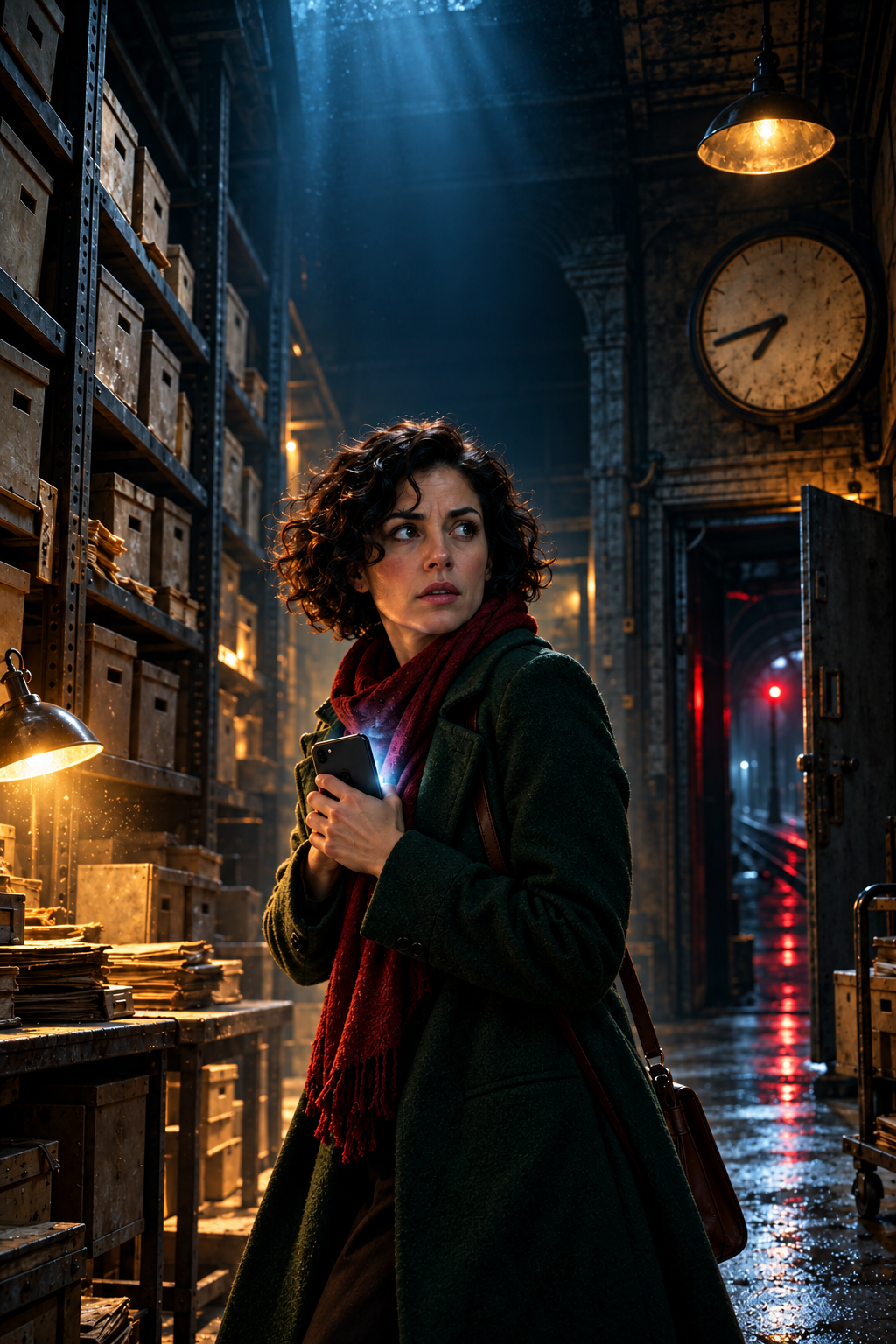
Section M had once belonged to the old records storage area. The compartments were numbered and covered with dust.
The key opened number 17.
Inside was a black book, several copies of death certificates and an envelope containing photographs.
The book contained names, dates and amounts of money.
Some names were marked with a red cross.
Others were accompanied by the word replacement.
Clara recognised several surnames belonging to people who had supposedly died years earlier.
—These people are not dead —Lobo said.
—How do you know?
—Two of them are still receiving pensions abroad. One appears in a property record in Morocco.
Clara turned the pages.
One of them contained Andrés Rivas’s name.
Beside it was a future date.
The date of his death.
Underneath, there was a note:
The test body will be delivered during the night shift.
Clara felt cold in her hands.
—Nicolás was the test body.
—Barea wanted to know whether the system would accept a false identity before registering Rivas’s death.
—But why kill him afterwards?
—Because he found the book.
A noise came from the corridor.
Lobo closed the book.
—Turn off the light.
They remained motionless.
A shadow passed beneath the door.
Then they heard a key turning in the lock.
—They have locked the entrance —Clara whispered.
—Barea?
—Or Roca.
—Who is Roca?
Clara pointed to one of the photographs.
It showed a man in a dark suit standing beside a funeral home.
Esteban Roca. Director of Orbe Funeral Services.
On the back of the photograph, Rivas had written a note:
Orta knew who received the bodies. Barea knew who claimed them. Roca decided who disappeared.
—Orbe Funeral Services handled every transfer connected to the marked names —Lobo said.
The door opened.
Dr Barea entered with Esteban Roca.
—Put the book on the floor —Roca ordered.
Lobo drew her weapon.
—You are under arrest.
Roca closed the door behind him.
—You have no authority to arrest anyone here.
—I have a search warrant and enough evidence to request your arrest.
Barea looked at Clara.
—I told you that you did not know what you were involved in.
—I do now.
Roca moved towards them.
—The book proves nothing. They are old records with no legal value.
—They prove that you forged death certificates —Lobo said.
—They prove that someone wrote some notes.
Clara raised one of the photographs.
It showed Nicolás Orta beside an ambulance. On the back, Rivas had written:
Orta knew who received the bodies. Barea knew who claimed them. Roca decided who disappeared.
Roca’s expression changed.
—Give me that.
Clara stepped back.
Barea lunged at her.
Lobo tried to stop her, but Roca struck the lamp and the room went dark.
Clara ran towards the door.
An arm grabbed her from behind.
She recognised the smell of disinfectant that clung to Barea’s clothes.
—Your name is already in the record —the doctor whispered. —Tomorrow, nobody will doubt that the body is yours.
Clara struck backwards with her elbow. Barea lost her balance.
In the darkness, Clara found the wall and pressed the emergency switch.
Red lights came on.
Lobo had Roca pinned to the floor.
Barea ran towards the exit.
Clara threw the book at her feet.
The doctor fell.
Lobo reached her before she could stand.
—Lucía Barea, you are under arrest for murder, document forgery and concealment of evidence.
Barea looked at Clara.
—You have no idea how many people needed to disappear.
—That did not give you the right to decide who lived and who died.
The investigation revealed that Barea and Roca had created a network of false identities over more than a decade.
Some clients wanted to escape debts or legal proceedings. Others wanted to collect insurance policies and inheritances. They paid to be declared dead and received new documents in another country.
To create those deaths, they used unidentified bodies.
Nicolás Orta had taken part in the transfers. When he decided to expose the network, Barea killed him and kept his body for years in a private facility.
Andrés Rivas discovered the system while reviewing Nicolás’s old case. He prepared the M-17 book and planned to hand it over to the police.
Barea registered Nicolás’s body under Rivas’s name to send him a warning. Then Roca murdered Rivas in his study and the two men removed his body from the morgue to erase the connection.
Clara’s signature had been forged to make her responsible for the illegal entry.
The record of her own death had been scheduled for seven forty-two because that was the time when the system automatically validated night transfers.
A week later, Clara returned to work at the morgue.
Chamber four remained closed.
Inside, there was only the stretcher and an unnamed tag.
Clara placed it inside an evidence box.
Before leaving, she checked the system.
The record of her death had been deleted.
In its place was a new entry:
Nicolás Orta. Identity confirmed.
Clara turned off the monitor.
For several seconds, she listened to the hum of the refrigerated chambers.
Then, from the empty room, she heard the sound of a metal door closing.
This time, Clara felt no fear.
She only remembered the first line in Rivas’s book:
Nobody disappears completely while someone preserves their name.
- #cuento
- #clara
- #rivas
- #barea
- #looked