The Book That Wrote the Future
· 10 min read
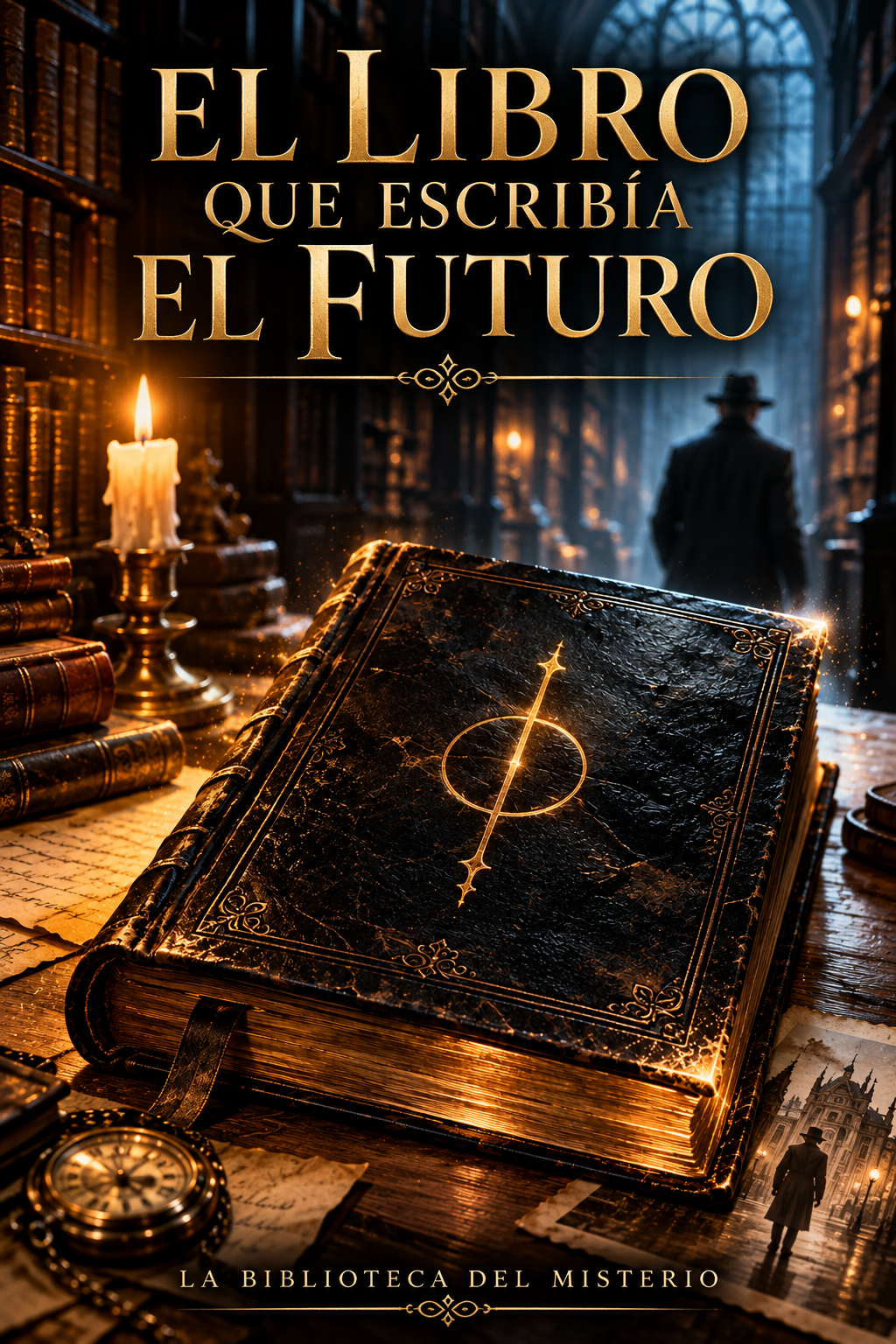
Daniel was about to close the library when he found a black book lying on the counter. He did not remember seeing it before. It had no title, no author's name, and no label that…
Part 1 — Open case
Daniel was about to close the library when he found a black book lying on the counter.
He did not remember seeing it before. It had no title, no author's name, and no label that could help identify it. It was an old volume with a dark cover and a strange symbol engraved in the center.
He opened it out of curiosity.
The first few pages were blank. On the seventh page, however, he found a sentence written in black ink:
“Tomorrow, at 6:42 p.m., a man dressed in gray will enter this library and ask for a book that never existed.”
Daniel let out a quiet laugh.
Someone must have been playing a prank on him. He closed the book, placed it in a drawer, and went home.
The following day, at 6:41 p.m., the library door opened.
A tall man wearing a gray overcoat walked inside. His hair was completely white, and he had a strange expression, as though he had been waiting for this moment for a very long time.
He approached the counter.
“Good evening. I'm looking for a book.”
Daniel looked up.
“Do you know the title?”
“It has no title. It never did.”
The clock on the wall struck 6:42.
Daniel felt a chill run down his spine.
“Who told you about that book?”
The stranger did not answer. Instead, he looked toward the drawer where Daniel had placed the black volume.
“So you've already found it.”
Daniel froze.
“How do you know it's here?”
The man leaned slightly toward him.
“Because I was the last person to read it.”
“What is so special about it?”
“It writes things that haven't happened yet. And when someone reaches its final page, they stop being the masters of their own fate.”
Daniel tried to laugh, but no sound came out.
“That's ridiculous.”
“I wish it were.”
The man turned toward the door. Before leaving, he stopped and added:
“Do not read what is written after your name. And above all, do not let the book reach its end.”
“Wait! Who are you?”
The stranger looked at him one last time.
“Someone who made the mistake of believing he could change what was written.”
Then he walked out into the street.
Daniel hurried after him a few seconds later, but there was no sign of the man. The street was empty, and rain was falling over the pavement.
When Daniel returned to the counter, the book was open.
A new paragraph had appeared.
“Daniel will search for the truth about his mother. He will find a photograph hidden behind the third bookshelf in the old reading room. There, he will discover that his mother did not die on the day he was told she did.”
Daniel's heart began to pound.
His mother had died when he was twelve. According to his father, she had been killed in a car accident. Daniel had never seen her body, and although he had asked questions as a child, he had eventually accepted the explanation he had been given.
But what did she have to do with that book?
Without thinking twice, he headed to the old reading room. Behind the third bookshelf, he found a small wooden box covered in dust.
Inside was a photograph of his mother, much younger, standing in front of the very same library.
Two men stood beside her.
One was the stranger in the gray overcoat.
The other was Daniel's father.
Daniel turned the photograph over. On the back, written in his mother's handwriting, was a sentence:
“If you ever find the book, do not trust the man in gray. He does not want to destroy it. He wants to finish it.”
Beneath the photograph lay a small key and a note.
“The final page is beneath the floor of the reading room. Forgive me, my son. Not everything you remember is true.”
Daniel returned to the counter with trembling hands.
The book had turned to a new page.
“Tomorrow, Daniel will discover who wrote this book. But first, he will have to learn the truth about his own death.”
Daniel read the sentence several times.
Then he looked at his mother's photograph.
For the first time, he wondered whether the accident had ever happened at all.
And he realized that the book was not simply predicting what was going to happen.
It seemed to know secrets no one should ever know.
Even the secrets his own family had buried.
Part 2 — Resolution
Daniel waited until the library was empty.
Using the key he had found with the photograph, he opened a hidden compartment beneath the reading room floor. Inside, he discovered an old diary, several letters, and another photograph.
This one showed Daniel as a little boy, sitting in front of the black book. His mother stood behind him, one hand resting on his shoulder. The man in the gray overcoat watched them from the doorway.
Daniel opened the diary.
The first page was dated seventeen years earlier and contained a sentence written in his mother's handwriting:
“Today, I understood that the book does not predict the future. It remembers it.”
He kept reading.
His mother had worked at the library many years before him. One day, she had found the black volume among the documents belonging to the former director. At first, she had assumed it was an unfinished manuscript. Then she discovered that its pages described events before they happened.
But there was something more.
Anyone who read the book to the very end became trapped in the story it wrote. Their decisions, their mistakes, and even their deaths became part of its pages.
The man in gray had been the last person to read the book in its entirety. Since then, he had not aged.
Daniel's mother had tried to destroy the book, but she had failed. Eventually, she realized that the only way to stop it was to write something the book had not foreseen.
The final entry in the diary read:
“I have faked my death to protect my son. His father will help me disappear. If the book ever falls into Daniel's hands, it will mean I failed to keep him away from this story.”
Daniel felt as though the air had been knocked out of him.
His mother had not died in that accident.
She had disappeared to protect him.
At the end of the diary, he found a letter addressed to him.
“My dear Daniel, if you are reading this, forgive me for all the years we have lost. I do not know whether we will ever see each other again, but I want you to remember one thing: the book can only control those who believe its words are inevitable. Do not surrender your will to it. Write something it cannot know.”
A noise made him turn around.
The man in the gray overcoat was standing in the doorway.
“I warned you not to come this far,” he said.
Daniel stood up.
“Where is my mother?”
The man lowered his eyes.
“I don't know.”
“You were with her in those photographs. You knew what was happening. Why didn't you help her?”
“I tried. But your mother understood something that took me far too long to accept.”
“What?”
The man looked toward the counter, where the black book had reappeared.
“That the book does not need to control the future. It only needs to convince its readers that they cannot change it.”
The pages began turning by themselves.
They stopped at the very last one.
A sentence slowly appeared before Daniel's eyes:
“Daniel will finish reading this page. He will understand that his mother is dead and that he will never see her again. Then he will take the place of the man in gray and remain in the library until another reader finds the book.”
Daniel felt anger burning in his chest.
The book wanted to force him to accept another lie.
He looked at the stranger.
“What happens if I don't do what it says?”
“I don't know,” the man replied. “No one has ever dared to try.”
Daniel picked up a pen from the desk.
The man took a step toward him.
“If you write on that page, there will be no turning back.”
“And if I write nothing?”
“The book will finish the story for you.”
Daniel stared at the words about his mother. For seventeen years, he had lived believing she was dead. Now he knew that someone had decided what he should remember and what he should believe.
He would not let a book do that to him again.
He placed the pen against the final page and wrote:
“Tomorrow, the book will stop writing the future.”
For a few seconds, nothing happened.
Then the letters began to disappear.
One by one, the sentences faded until every page was blank. The symbol on the cover cracked, and the book snapped shut.
The man in the gray overcoat fell to his knees.
His hair began to darken, and wrinkles appeared across his face. Within moments, he seemed to have aged many years.
“What have you done?” he whispered.
Daniel put down the pen.
“I chose my own ending.”
The man raised his head and smiled sadly.
“Then perhaps there is still hope.”
And he disappeared.
Daniel searched the entire library but found no trace of him.
The next morning, he placed the book inside a box and locked it away in a basement cupboard. Then he returned to his desk, exhausted, convinced that everything was finally over.
That was when he noticed an envelope someone had left on the counter.
His name was written on the front.
Inside was a recent photograph of a woman sitting in a café. Her hair was gray, there were wrinkles around her eyes, and a small scar marked her chin.
Daniel recognized that scar immediately.
His mother had received it when he was six years old, after falling while repairing a bookshelf.
On the back of the photograph was an address and five words:
“Forgive me for taking so long, son.”
Daniel pressed the photograph against his chest.
For the first time in seventeen years, he cried without feeling that he was saying goodbye to someone.
That very afternoon, he boarded a train to the address on the photograph.
He did not know what he would find there, or whether his mother could explain all the lost years. But he was ready to find out for himself.
He believed the mystery was over.
Until that night, when a boy found a black book on the table in his bedroom.
It had no title and no author's name.
The first page was blank.
On the second page, a sentence had been written in black ink:
“Tomorrow, you will meet a man named Daniel. He will tell you that books cannot write the future.”
The boy smiled and turned the page.
Somewhere in the city, Daniel had just discovered that the future belonged to him.
But perhaps the book had never needed to write it.
Perhaps it only needed to find someone willing to believe in it.
- #cuento
- #daniel
- #mother
- #about
- #photograph
More stories
See archive →
Cuento
The Night Shift at the Morgue
At two seventeen in the morning, Clara Montes received a body registered under the name of a man who was still alive. The night shift at the municipal morgue usually passed without surprises. A road…
23 October 2026 · 6 min read
Cuento
The Message That Arrived Tomorrow
At nine fourteen that evening, Inés received a voice message sent from her own mobile phone. The message appeared in a conversation with herself, which she used to save notes. The sending date showed the…
22 October 2026 · 4 min read